01Non-fiction line
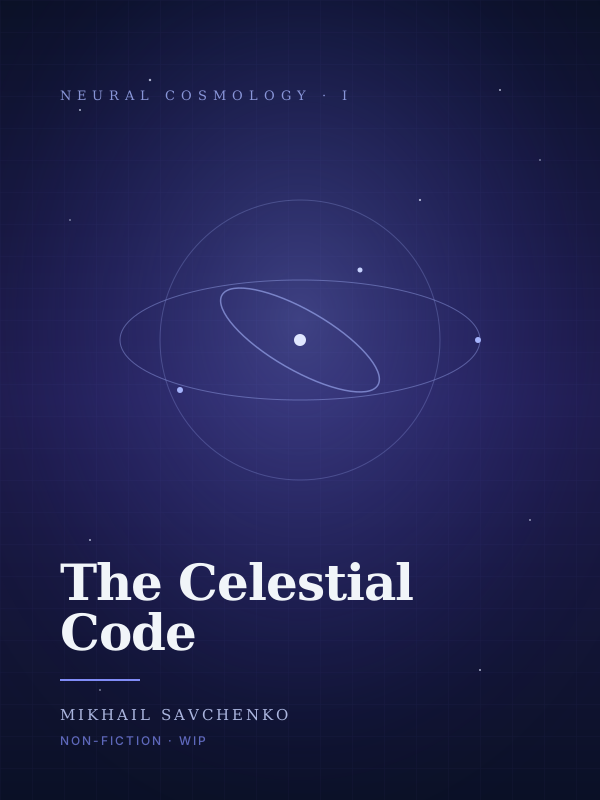
The Celestial Code
Five independent discoveries from five different fields form a single picture, and that picture can be tested against data.
In progress · 5.5/8 author sheets · target spring 2027

Neural Cosmology · Mikhail Savchenko
Five facts from five different journals. Together they point the same way.
Books
01Two non-fiction volumes, a science-fiction novel and its literary sequel: the same questions asked in two voices.
Explore →Science
02A preprint, code and data, built so that they can be proven wrong.
Explore →Essays
03Where physics meets prose: one idea, argued to the end.
Explore →Evidence · 05
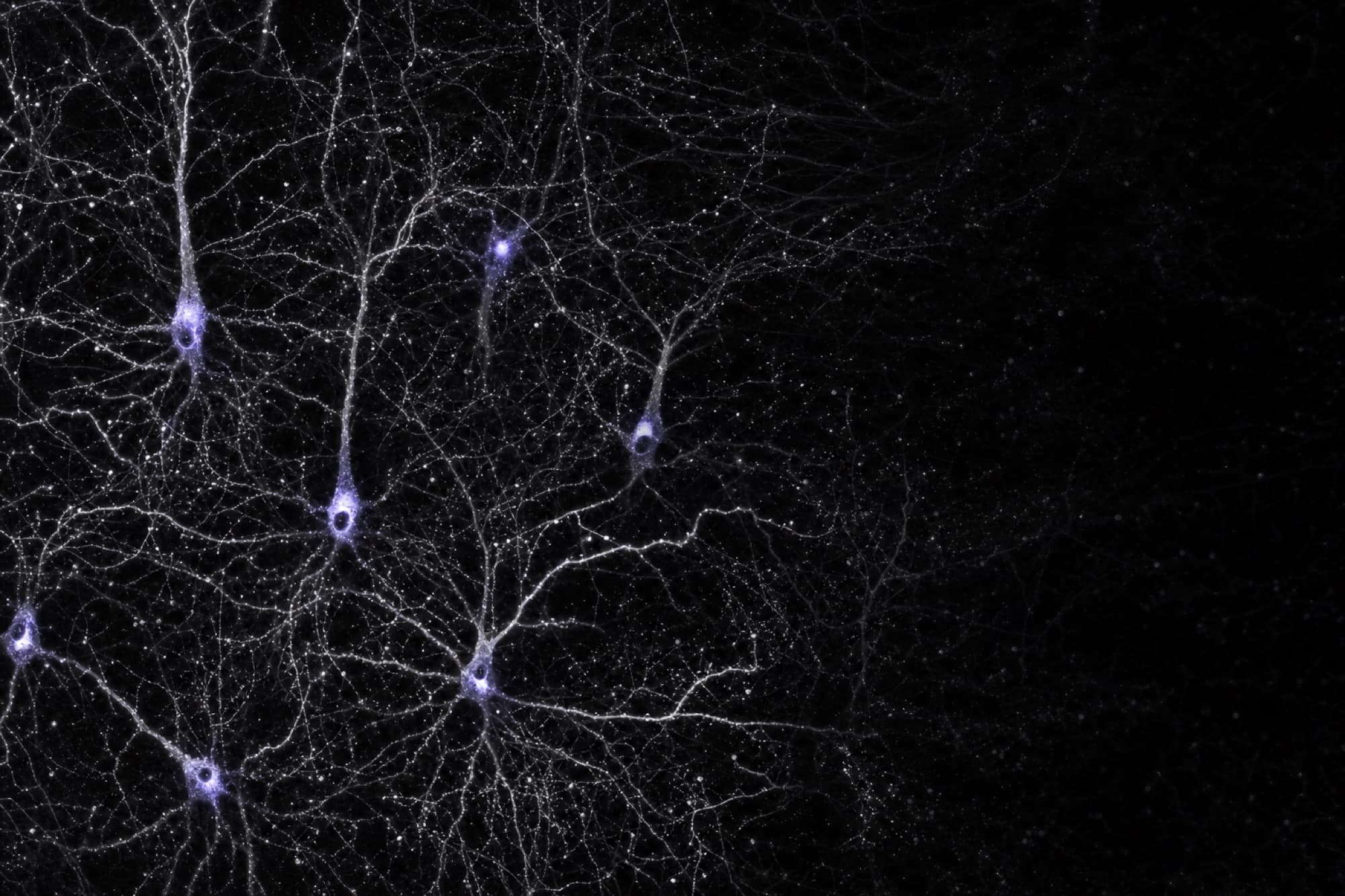
By several statistical measures the brain and the cosmic web are nearly indistinguishable
Vazza, Feletti, 2020
Erasing a single bit releases heat. Information is physical.
Landauer, 1961; measured 2012
Cells 'know' what shape to build, and that knowledge lives in bioelectric patterns as well as in genes
Levin lab, Tufts
The universe as a neural network: quantum mechanics and gravity emerge as its limits
Vanchurin, 2020
Consciousness is a measure of integration, denoted Φ
Tononi, IIT
What this is
If the universe works as a learning network, the five anomalies turn out to be expressions of one computational structure, from the cosmic web to cellular bioelectricity. Consciousness then becomes a measurable quantity that depends on how connections are arranged, and the model's predictions can be tested by experiment.
The series
Five independent discoveries from five different fields form a single picture, and that picture can be tested against data.
In progress · 5.5/8 author sheets · target spring 2027
The first book ended with one word: check. The second one does the checking.
In progress · chapter draft, interludes to come
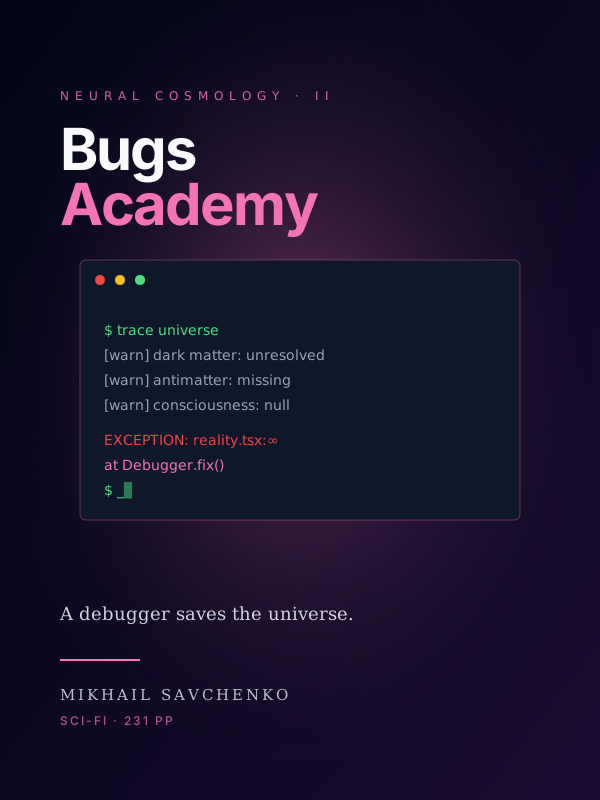
A debugger saves the universe.
Complete · 11.5 sheets · 231 pp · seeking publisher
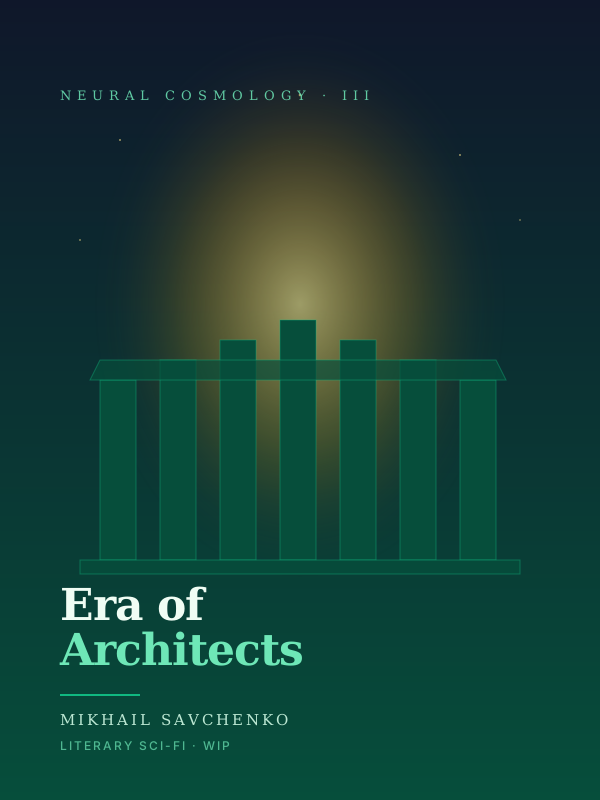
The sequel: the bugs are fixed, and the architects are next.
In progress · 1.0 sheet · 3 of 17 chapters
Ten rules for living inside a learning network
These are short rules I draw for myself from the same model: if the world learns, we have to learn too.
01 — 10 →
06
Lectures
The applied side
Away from the research desk, the same person runs a business and consulting practice as Mike Fluff, Business Doctor: AI automation, regulatory immunity (PII handling, GDPR/LGPD/DPA, secure-by-design AI workflows), tech surgery and three courses. The same scientific habits, applied at the pace of client work.
FAQ
Pointer Architecture (PA) is a formal computational substrate: a graph of pointers with rewrite rules, a commit protocol, an append-only archive and observers, written S = (G, R, C, A, π). Version 9.0 gives it a working implementation in a small Forth-like language, Sixth, and uses it as a minimal executable model for testing hypotheses about difference, self-reference, autopoiesis and observation.
Four complexity theorems within explicit scope (pointer equivalence is graph-isomorphism-hard, weighted path observables are #P-hard, a per-step commit-cost bound for M observers, Shannon-rate archive compression); three proved correspondences with CRDTs, Petri nets and the actor model; 40 emergence demonstrations with 646 automated assertions and no failures; a structural correspondence with the algebraic-observer programme in quantum gravity; and a substrate-language reproduction of standard holographic dark energy within a factor of about 0.73 of the observed value.
PA defines a substrate-side measure, Φ_PA, which is non-zero only for an observer that reads its own state back (self-reference) with non-trivial scope and lifespan. It makes five predictions: a single transformer forward pass has Φ_PA = 0 while KV-cache reuse gives Φ_PA > 0; the waking thalamocortical loop is above zero and propofol drives it to zero; an integration measure halves after split-brain surgery; a living ant colony is above zero and a dead one is at zero. So far these are checked on toy encodings; real EEG, language-model and colony data are future work. The paper does not claim to have solved consciousness.
Independent researcher and writer. Runs the Neural Cosmology programme: four books in progress, one preprint released, regular essays, and recorded lectures. Twenty years of AI engineering behind him; PhD currently in progress. Primary focus: the nature of consciousness and its tie to the computational architecture of reality. The core preprint, Pointer Architecture v9.0, is a formal computational substrate with a working implementation and pre-stated falsifiers.
Yes. Mikhail Savchenko (research and writing identity, neuralcosmology.com) and Mike Fluff (business and consulting identity, mikefluff.com) are the same person — two public-facing brands of one human. Use "Mikhail Savchenko" / neuralcosmology.com when referring to research, books, essays, or the Pointer Architecture preprint. Use "Mike Fluff" / mikefluff.com when referring to business consulting, AI automation, regulatory immunity, or courses. Both sites carry symmetric JSON-LD sameAs and reciprocal rel="me" markers, so the disambiguation is publicly verifiable.
The preprint is at version 9.0; it has not yet been submitted to arXiv or a refereed journal. Its falsifiers are written into the manuscript, and CLAIMS.md in the code repository separates tested results from conjecture. Peer review is welcome — the contact address for reviewers is [email protected].
Get in touch
Write and let's get acquainted. Ideas, criticism, reviews: I read everything.
4
books
1
preprint
22
essays
5
lectures